
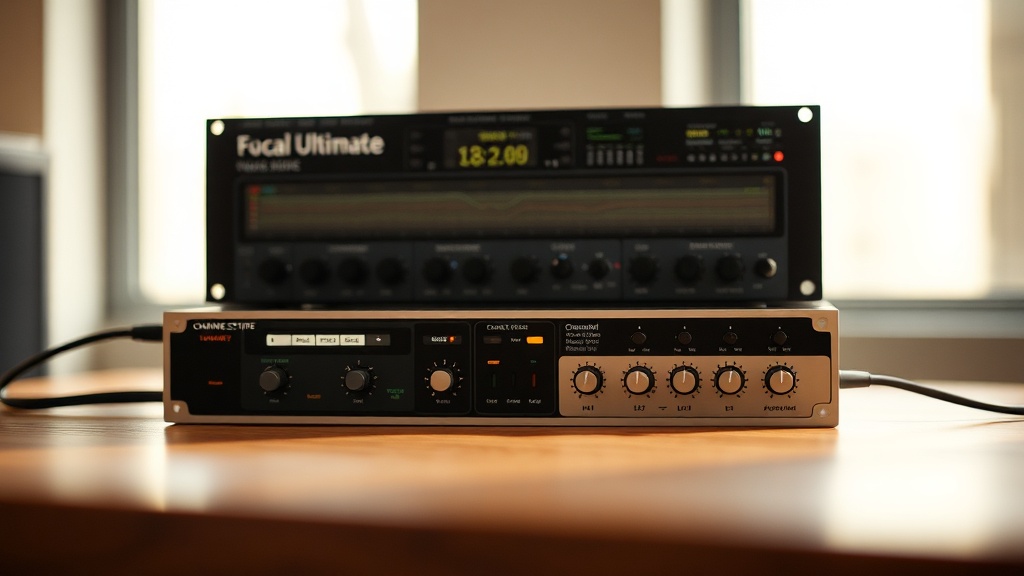
Why Channel Strip Plugins Excel at Vocal Processing
The relationship between EQ bandwidth and the perceived naturalness of frequency adjustments affects how transparent the processing sounds to the listener. Broad EQ adjustments tend to sound more natural and musical because they affect a wide range of harmonics simultaneously, preserving the overall tonal character of the instrument. Narrow adjustments can sound unnatural because they affect a specific harmonic in isolation, creating a resonant or notched quality. Using the widest bandwidth that achieves the desired effect produces the most transparent results.
Ideal Signal Chain Order for Vocal Channel Strips
Processing acoustic guitar through a channel strip plugin addresses the instrument's wide dynamic range and complex tonal characteristics. A high-pass filter set between 80 and 120 Hz removes low-frequency body resonance that can cloud a mix. Subtractive EQ in the 200 to 400 Hz range reduces boomy proximity effect from close microphone placement. Gentle compression with a slow attack preserves the percussive strumming transient while controlling the sustain of fingerpicked passages.
Modern channel strip plugins often include advanced features like linear-phase EQ modes, dynamic EQ bands, and multiband compression that go beyond what was possible with the original analog hardware. These hybrid designs combine the warmth and character of analog modeling with the precision and flexibility of digital processing. While purists may prefer channel strips that strictly emulate the original hardware limitations, these expanded feature sets provide practical tools that solve real mixing problems.
The concept of surgical versus musical EQ use relates directly to the design philosophy of different channel strip plugins. Surgical EQ requires narrow bandwidth, precise frequency selection, and exact gain control, which SSL-style parametric EQs excel at providing. Musical EQ uses broader curves, fixed frequency selections, and gentler adjustments, which Neve and API-style EQs are designed to deliver. Both approaches have their place in mixing, and the most effective engineers switch between surgical and musical EQ techniques as needed.
EQ Settings for Clear and Present Vocals
Home studio producers often wonder whether investing in an expensive channel strip plugin will significantly improve their mixes. The truth is that proper gain staging, room treatment, and monitoring accuracy have a far greater impact on mix quality than any individual plugin. However, a well-chosen channel strip plugin can streamline your workflow and help you achieve more consistent results across different projects. Start with free or affordable options and upgrade only when you have clearly identified what your current tools cannot accomplish.
The semi-parametric EQ found in many classic channel strip designs offers a middle ground between fully parametric and fixed-frequency topologies. With adjustable frequency selection but fixed bandwidth, semi-parametric EQs encourage decisive tonal shaping without the option paralysis that fully parametric bands can introduce. Channel strips modeled after the Neve 1084 and API 550A both feature semi-parametric EQ sections that have shaped the sound of countless recordings. Their streamlined controls help engineers work quickly and musically.
The concept of analog emulation in audio processing seeks to recreate the sonic characteristics of vintage analog equipment using digital algorithms. Modern emulation technology can model the behavior of individual electronic components including resistors, capacitors, inductors, transformers, and vacuum tubes. These component-level models capture the nonlinear behaviors that give analog equipment its distinctive tonal character. The accuracy of analog emulations has improved dramatically in recent years, narrowing the sonic gap between digital processing and original hardware.
Compression Techniques for Vocal Dynamics Control
Free channel strip plugins have improved dramatically in recent years, with some rivaling paid alternatives in sound quality. Developers like Analog Obsession, TDR, and Airwindows offer excellent no-cost options that deliver genuine console character. While free channel strips may lack the polished interfaces of premium plugins, their sonic capabilities make them perfectly suitable for professional work. Home studio producers on tight budgets should explore these options before investing in expensive alternatives.
De-Esser and Gate Settings Within Channel Strip Plugins
The practice of using metering tools alongside critical listening provides a multi-sensory approach to mixing that catches problems either sense might miss alone. Meters reveal numerical truths about signal levels, frequency balance, and stereo correlation that the ear might not detect, especially in fatigued listening conditions. Ears perceive musical qualities like warmth, punch, and clarity that meters cannot quantify. The combination of objective measurement and subjective perception produces the most accurate and musical mixing decisions.
The concept of tube saturation in audio processing refers to the harmonic distortion generated when audio signals pass through vacuum tube amplification stages. Tubes produce a characteristic pattern of harmonics dominated by even-order content, particularly the second harmonic, which is perceived as warm, full, and musical. As the drive level increases, the harmonic content shifts to include more odd-order harmonics, adding edge and grit. This continuously variable tonal character makes tube saturation a versatile creative tool.
The concept of source-dependent processing recognizes that different instruments and recording situations require different processing approaches. A vocal recorded in a well-treated studio needs different EQ treatment than one recorded in a bedroom. A drum kit miked with close microphones requires different compression than one captured with a distant stereo pair. Adapting your processing approach to the specific characteristics of each source produces more natural results than applying fixed processing templates regardless of the recording quality.
Best Channel Strip Plugins Specifically for Vocals
SoundShockAudio encourages producers to attend online and in-person workshops focused on channel strip plugin techniques and mixing fundamentals. Industry events like the AES Convention, NAMM, and Mix with the Masters feature sessions by top engineers demonstrating their channel strip workflows. These educational opportunities provide insights that are difficult to obtain through independent study. Learning from experienced professionals accelerates your development as a mixing engineer and helps you use channel strip plugins more effectively.
Advanced Vocal Processing Techniques With Channel Strips
The relationship between compression and perceived loudness is central to modern mixing and mastering practice. Compression reduces the dynamic range by attenuating loud peaks, which allows the overall level to be raised without clipping. This increase in average level creates the perception of louder playback. However, excessive compression removes the dynamic variation that gives music its emotional impact. Finding the balance between perceived loudness and dynamic expression is one of the most important decisions in the mixing and mastering process.